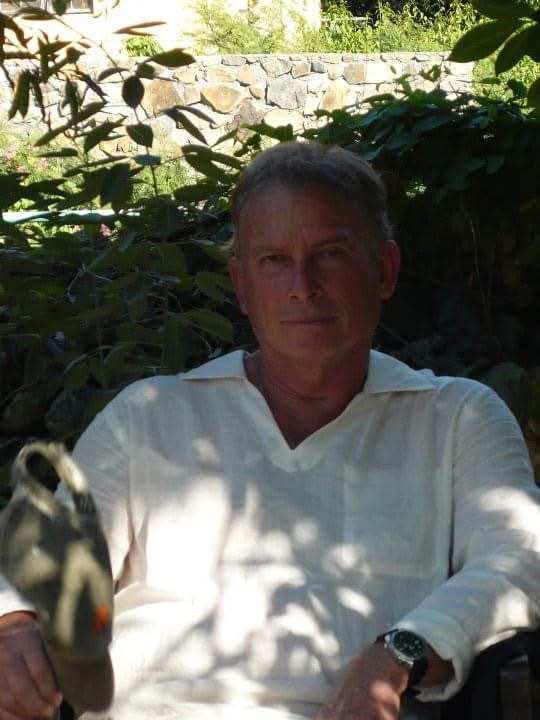
Biography
Francis Eck (born 1949, Alsace) has spent more than four decades forging a singular body of work where light, matter, and energy merge into one continuous flow. Based in the Caribbean since the late 1980s, he has developed a vibrant, immediate, and intensely physical approach to painting — an art of sensation, breath, and controlled impact.
Deeply influenced by Eastern philosophy and the discipline of Japanese martial arts, his practice unfolds like an inner ritual. Before the gesture comes silence, focus, the rise of energy. Then the decisive moment arrives: “I meditate for a long time in my hammock. Then I get up and paint five canvases.” This surrender to the creative instant — already noted by François de Caunes — underpins a painting driven by raw vitality and the “hitting point” evoked by Nicolas de Staël. Art critics quickly recognized the uniqueness of his vision. Gérard Xuriguera described Eck as a painter of “pure suggestion,” capable of condensing the forces of the world into living chromatic architectures. Pierre J. Marczell highlighted the tectonic nature of his compositions — built from chromatic collisions, shifts, and underlying tensions. Rui Manuel de Sousa Rocha spoke of an “intact inner truth,” while poet Cecília Moura wrote that his paintings are “what clings to the soul and refuses to leave.” Gladys Maccabe, François de Caunes, and Gautherie-Kampka also emphasized the total authenticity of his gesture and the atmospheric power of his light. His work has been featured in Asahi Shimbun and on the cultural network NHK.
Highlights
Eck’s career spans several continents. He has exhibited at Art Expo New York, Shanghai Art Fair, Beijing Art Expo, Hong Kong International Art Fair, the Yomena Nohana Museum in Tokyo, the Beijing Art Museum, and in galleries across France, Switzerland, Germany, the United Kingdom, Guadeloupe, and Saint-Martin. He has received major distinctions including the Grand Prix Rubens, the Gold Medal of the Salon d’Enghien, several Europ’Art awards, and the First Prize of the China Art Expo (Beijing). His work is referenced in the Dictionnaire Drouot Cotation and Who’s Who in International Art. For Eck, nature is never decorative. It is force, breath, tension — a natura naturans in the Spinozian sense. His landscapes do not illustrate; they emerge from the collision between Caribbean light and a stripped-down gestural vocabulary where each color carries weight, movement, and vibration. Francis Eck paints what moves in the world — and what moves within us. His work is a passage. His gesture, an entire life condensed into the instant.